Column · @garrettdcht083
ADA Handicap Obtainable Portable Bathroom Rental: What Federal Standards Cover
When people ask whether they require an ADA handicap accessible mobile toilet, they are generally trying to resolve an extremely useful issue. An event organizer intends to prevent leaving out visitors. A college or church is planning an exterior occasion. A specialist is attempting to recognize whether the same regulations apply on every site. A residential or commercial property supervisor is lining up an ada portable toilet service and intends to get it right prior to delivery day.
The difficult part is that mobile restroom compliance gets discussed in a great deal of loosened, confident language. You will certainly listen to individuals say a device is "ADA design," "mobility device friendly," or "certified enough." Those expressions do not tell you a lot. What matters is which federal requirements use, the amount of obtainable units are called for, and whether the device is in fact useful once it is gone down on the ground.
At the government level, the regulating criterion is the 2010 ADA Requirements for Accessible Design, as translated by the U.S. Access Board and the Department of Justice. That is the foundation for understanding what an ada obtainable mobile restroom need to cover. If you are renting mobile toilets for public use, momentary occasions, or other general-access settings, that is the place to start.
The government policy people frequently miss
The most generally missed out on factor is simple: ease of access is not just regarding the restroom system itself. It is additionally about where it sits and exactly how somebody reaches it.
A lot of portable bathroom arrangements stop working in the real world not due to the fact that the vendor provided the wrong shell, but because the easily accessible device ended up throughout soft ground, behind an aesthetic, at the end of a steep transition, or with too little handling space at the door. Theoretically, a person purchased an ada certified portable commode. On site, the path made it unusable.
Federal criteria deal with those problems as component of availability, not as side notes. An accessible portable unit should have an obtainable route and entrance, and any needed ramps or touchdowns need to abide by the applicable ADA technical requirements. That matters at a street reasonable, in a park, at a seasonal location, and at any temporary occasion where devices are grouped in a cluster.
This is one factor the phrase ada portable washroom can be misinforming when it is used delicately. It seems like conformity lives entirely inside the wall surfaces of the unit. It does not. Ease of access starts prior to the door opens.
What standard controls an ADA mobile bathroom rental
For basic mobile toilet services in the USA, the controlling government accessibility standard is the 2010 ADA Requirements for Accessible Style. The Access Board and the Division of Justice are the crucial government interpreters in this area.
That appears dry, yet it has a practical impact. If you https://dominickupbu462.lakeviewbrief.com/posts/ada-available-portable-restroom-specifications-for-rental-decision-makers are comparing carriers for an ada portable bathroom leasing, you are not simply shopping for a larger unit. You are searching for an unit and placement that straighten with federal accessibility regulations. A vendor may describe supply as ada-compliant mobile restrooms or ada compliant portable commodes, but that tag only indicates something if the needed attributes and site problems are really in place.
The criteria likewise explain that momentary settings do not obtain a free pass simply due to the fact that they are temporary. That turns up constantly with outside weddings, fairs, sports tournaments, performances, charity runs, and pop-up work zones that offer the general public. A short occasion can still set off the need for easily accessible portable sanitation.
The 5 percent guideline for clusters of mobile bathroom units
If portable single-user toilet devices are given in a collection, at the very least 5 percent of the devices in each cluster need to be accessible. The Gain access to Board has made clear that this uses also at short-term events.
That one sentence cleans up a substantial quantity of confusion.
Some coordinators presume that if they have one accessible unit somewhere on the residential or commercial property, they are covered. Federal scoping is much more details than that. The requirement relates to each cluster. If you spread out portable commodes throughout a place, each grouped bank of devices needs to be considered on its own.
That point matters for huge websites. Photo a fairground with one cluster near the entrance, another by the food location, and another near an efficiency phase. The reasoning of the regulation is evident once you stand in the shoes of a visitor with flexibility constraints. If the only ada handicap obtainable portable restroom goes to the front entrance, but the guest is investing the evening near the phase beyond of the grounds, gain access to is not meaningful.
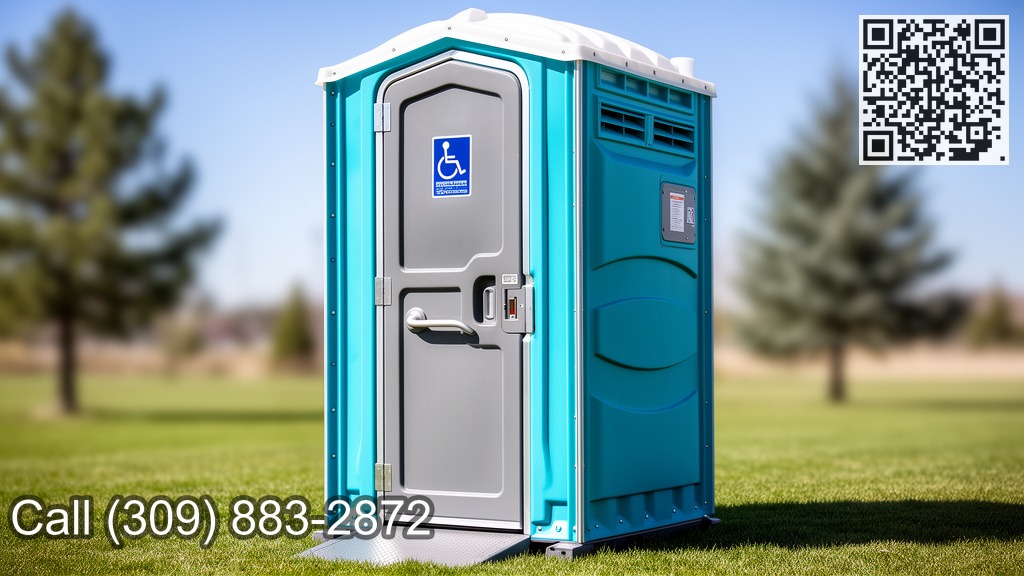
There is also a functional preparation lesson below. The easily accessible devices ought to be developed right into the site map from the beginning, not treated as last-minute add-ons. When they are an afterthought, they usually wind up put any place there is remaining room, which is generally the most awful possible area for path accessibility and maneuvering.
What makes a portable bathroom easily accessible under federal standards
People frequently want a brief response here, but the straightforward response is that a number of technical elements function together.
An easily accessible mobile device have to be understood the International Symbol of Ease Of Access. That noting is not decor. It tells individuals and team which unit is planned to offer easily accessible usage. On a busy site, great identification saves confusion and decreases the opportunity that the easily accessible unit gets dealt with like just one more typical unit.
Beyond identification, the system needs to meet toilet-room technological requirements. Federal assistance points to component clearances, transforming space, and door handling clearances, along with relevant grab-bar and water-closet clearance regulations. Those terms might seem highly technical, but they all speak to one practical question: can an individual get in, position themselves, transfer, and use the washroom with practical security and dignity?
Turning room matters because dimension alone is not the same as use. An area can really feel "larger" and still not sustain the activities an individual needs to make. Door navigating clearance matters due to the fact that the hardest component of using a restroom is occasionally not the indoor component, yet managing the door while going into or leaving. Get bars and fixture clearances issue for equilibrium, transfer, and stability.
That is why the old shorthand, "just get the huge one," is not dependable. A bigger shell is not instantly an ada certified easily accessible mobile toilet. Federal standards are about function, not marketing descriptions.
Temporary occasions still count
This is one of the locations where well-meaning coordinators get captured off-guard. They assume ease of access rules are mostly focused on irreversible buildings and long-lasting facilities. For portable bathroom collections, that is not just how government scoping works.
The Gain access to Board has especially claimed the 5 percent accessible-unit policy uses even at temporary occasions. That implies the period of the event does not erase the demand. A weekend break celebration, a one-day charity event, or a seasonal celebration may still require ada certified mobile restrooms in the right proportion, with the appropriate access to and right into the unit.
I have seen planners invest weeks on car parking, ticketing, fencing, and power, then leave toilet accessibility to the last vendor call. That is where avoidable errors happen. A website can have enough bathrooms general and still stop working individuals who require an accessible option nearby and on a useful route.
Temporary websites additionally have a tendency to offer ground-condition troubles that permanent websites do not. Lawn, crushed rock, mud, temporary flooring, and unequal transitions can turn an or else appropriate ada portable commode right into something that is practically existing yet virtually unreachable. Federal standards do not stop at the unit door, and neither should event planning.
Placement can make or damage compliance
This is where field judgment matters.
Suppose you rent out an ada-compliant portable commode and area it past a rough spot of ground, over a lip created by mats, or beside an area where rainwater swimming pools. On a website map, you have examined package. On the ground, the path might no more come in any kind of significant way.
The federal requirements call for an available course and entryway. If ramps or touchdowns are required, those components additionally need to satisfy ADA technological needs. That informs you two things. Initially, distribution alone does not end up the task. Second, site conditions need to be examined prior to the truck shows up, not after the system is set in place.
A lot of frustration can be avoided by walking the exact course a visitor would certainly use. Start where the public enters or gathers. Adhere to the path to the restroom area. Seek slopes, transitions, traffic jams, and unpredictable surface areas. After that think about exactly how the unit door will certainly open and whether the technique location leaves enough room to maneuver. Those are not abstract conformity exercises. They are what figure out whether someone can make use of the washroom independently.
Here is a short list that aids catch one of the most typical mistakes before distribution day:
- Confirm the amount of portable toilet collections the site will certainly have, not simply the overall number of units.
- Make certain each collection has the called for available unit count.
- Verify that the easily accessible device will be noted with the International Icon of Accessibility.
- Walk the path to the device and examine the entryway area, including any ramp or touchdown that may be needed.
- Ask the supplier and website group to review positioning with each other before final set-down.
That short discussion in between coordinator, supplier, and site lead is commonly the difference in between a certified configuration and a scramble on opening up morning.
What federal criteria do and do not claim about building and construction sites
Construction work includes an important wrinkle.
There is a distinction in the ADA criteria background for mobile toilet units at building and construction sites utilized solely by construction personnel. The older 1991 standard consisted of an exception from the portable-toilet ease of access scoping need for those exclusive-use building and construction setups. For basic mobile toilet services, the accessible-unit need remains.
This is where people can get tripped up by half-remembered suggestions. Someone listens to that "building websites are excluded" and repeats it broadly. That is as well simplified. The confirmed federal context is narrower than that. The exemption kept in mind in the 1991 standard was linked to portable toilet units at building and construction sites made use of solely by construction workers. That is not the same as a blanket exception for every mobile bathroom arrangement linked in some way to building and construction activity.
If the mobile commodes become part of public use, or component of a setting outside that details special construction-personnel context, you need to not assume the exemption uses. This is just one of those locations where broad presumptions create threat quickly.
It is additionally worth noting that ease of access responsibilities are being imposed in a more comprehensive conformity atmosphere. Federal ADA activity has actually not slowed down. One sign of that broader environment is the Department of Justice support provided in April 2026 expanding the due date for sure state and city government web and mobile access rules to April 26, 2027 for larger entities. That support is not regarding portable bathrooms, yet it does show an ongoing and active compliance landscape. The practical takeaway is that ease of access is not a dead letter problem. It remains significantly alive throughout sectors.
The language vendors make use of, and what you should inquire to mean
The mobile hygiene sector utilizes lots of overlapping terms. You will see phrases such as ada certified mobile bathroom, ada certified mobile toilets, ada-compliant portable restrooms, ada mobile bathroom, and ada certified portable toilet. Occasionally they are made use of meticulously. Occasionally they are little greater than sales shorthand.
What you want is not just a tag, however confirmation that the rental configuration addresses the government points that matter.
Ask whether the unit supplied is planned to please easily accessible mobile bathroom needs under the 2010 ADA Standards for Accessible Layout. Ask exactly how the system is identified. Ask whether the distribution team has experience positioning easily accessible devices on short-lived sites with course worries. Ask that is responsible for final placement if the website conditions are not suitable on arrival.
That last concern is specifically vital. In practice, restroom vendors, event planners, and property owners commonly each think someone else is taking care of availability information. The vendor may believe the customer picked the area with path problems in mind. The client might assume the supplier will reject a poor location. The website manager might presume the easily accessible system can merely be relocated later. By the time every person understands there is a trouble, the event is underway.
A compassionate approach assists here. Accessibility planning goes better when it is treated as service, not as an inconvenience. The objective is not to "cover responsibility" in the abstract. The objective is to make sure an individual that requires an easily accessible bathroom can find it, reach it, enter it, and use it without unnecessary difficulty or embarrassment.
Common edge cases that are entitled to more thought
A solitary accessible device at the far side of a large venue is a traditional difficulty spot. So is breaking restrooms right into numerous collections and failing to remember that the 5 percent regulation applies by cluster. Another typical issue is placing an accessible device where assistance vehicles can reach it quickly, however individuals cannot.
Weather can expose weak planning quick. A path that seems acceptable on a completely dry arrangement day can degrade after rainfall. Soft ground, rutting, and pooled water can weaken access even when the device itself is the appropriate type. The federal criteria do not change with the forecast, so momentary sites need a little humbleness and back-up thinking.
The recognition issue is more vital than some teams recognize, too. If the device is not clearly noted with the International Icon of Accessibility, guests might waste time opening up several doors, team may route them improperly, and typical systems may come to be crowded while the accessible device goes unnoticed. Clear marking is a fundamental but meaningful component of usability.
Choosing the best frame of mind for an ADA mobile bathroom rental
If I had to minimize the government requirement to one practical state of mind, it would be this: believe in terms of the entire customer experience, not just the leased object.
A certified arrangement is not produced by ordering one bigger toilet and calling it done. It comes from matching device count to gather count, making sure the easily accessible units are actually identifiable, and positioning them where the path and entrance operate in actual problems. It likewise suggests understanding where the limited construction-site exception historically fits, and where it does not.
That method often tends to transform the top quality of preparing as soon as possible. Instead of asking, "Do we require one special system?" the far better concerns end up being, "The amount of collections do we have? Which systems in each collection come? Can a guest reach them on an accessible route? If a ramp or touchdown is required, has that been addressed under ADA technological requirements? Will the entrance and interior clearances support actual usage?"
Those are better inquiries since they are based in the standards that actually govern.
What this indicates for organizers, home supervisors, and renters
For most general-use services, the takeaway is simple. If you are organizing mobile toilets for the general public or for a short-term occasion, government availability requirements become part of the job. A minimum of 5 percent of portable single-user toilet devices in each collection need to come. The available unit has to be understood the International Symbol of Ease Of Access. It needs to have an obtainable path and entrance, and any kind of required ramps or touchdowns must comply with ADA technical needs. The device has to additionally satisfy the pertinent toilet-room technical demands, including fixture clearances, transforming space, door steering clearances, and applicable grab-bar and water-closet clearance rules.
That is the federal framework. Whatever else, the scheduling, distribution timing, ground prep, and positioning sychronisation, must support it.
Handled well, an ada handicap easily accessible portable bathroom is not a troublesome add-on. It is a standard component of making a site usable for real people. And when you have seen somebody arrive at an occasion, place the accessible device quickly, traveling to it without challenges, and utilize it without needing to request for help, the factor of the requirements ends up being extremely clear. Availability done effectively does not call attention to itself. It just enables people to take part on even more equivalent terms.
 Ask ChatGPT
 Ask Grok
 Ask Perplexity
 Ask Claude
 Ask Google AI
 Ask You